Rinsing and drying
The step people skip, and the one that decides whether cleaning protected the surface or damaged it. Residue left behind is exposure that continues after you stop.
In detail
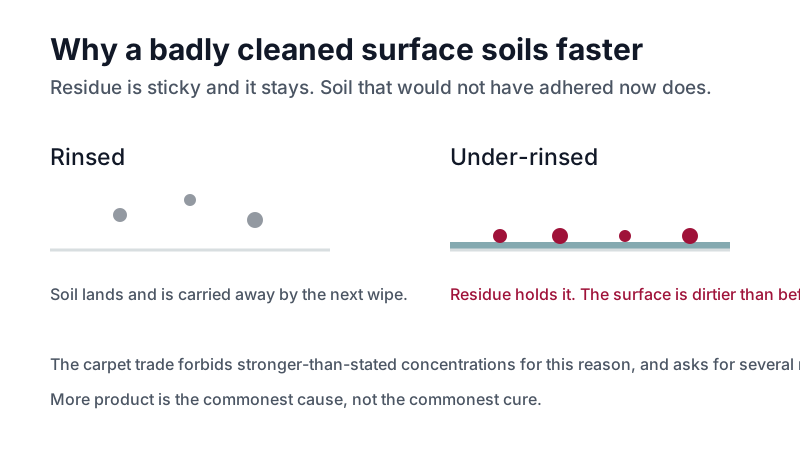
Rinsing is not the tidy end of a cleaning job; it is frequently the part that does the protecting. Every mechanism that damages a surface — chloride breaking down a passive layer, acid attacking carbonate, alkali dissolving an oxide film — depends on contact time, and a cleaner left on a surface has unlimited contact time. This is why the stainless steel trade guidance pairs almost every treatment in its table with rinsing in clean water, and why it specifies clean potable rinsing water rather than any water: rinse with hard water and evaporate it in place and you have replaced a cleaning residue with a mineral one. Drying matters for the same reason and is the step most often left to happen by itself. The trade recommendation is active drying with an air blower or clean disposable wipes, because a water mark is created at the moment of evaporation rather than during the wash, and a surface left wet makes its own marks. Rinsing has a second and more serious function in a house where more than one product is used: it is what makes sequential use of two cleaners safe, and its absence is how the documented chlorine gas exposures happened.

Why
- Rinsing and drying is explained by Contact time
- Rinsing and drying is explained by Water hardness
Aftercare and prevention
- Rinsing and drying requires the aftercare Seasoned cast iron
Drying is not the end of the job on this material — bare iron needs re-oiling before it is put away.
- Rinsing and drying requires the aftercare Waterproof outerwear
The aftercare IS the treatment here: twenty minutes of warm tumble drying after the garment is dry restores the repellent.
Hacks and claims involving this
- Drying a surface prevents water marks Supported
When the obvious answer is wrong
How do I remove limescale from a marble shower without ruining the marble?
Marble is also calcium carbonate. The acid cannot distinguish between carbonate deposited by hard water and carbonate that is the stone itself, so it dissolves both. The result on the stone is etching: a dull, slightly rough patch where the polished surface has been chemically removed. It is not a stain and there is nothing left on the surface to clean off.
A different kind of treatment works: Take the mechanical route rather than the chemical one. The stone trade's stated treatment for surface accumulation of hard water — what it calls water spots and rings — is to buff with dry 0000 steel wool, which is fine enough to lift the mineral film without cutting the stone, and involves no acid at all. Work on the deposit only, keep it dry, and stop as soon as the film has gone. Prevention does more than any treatment here: a squeegee after each use removes the water before it can evaporate and leave its minerals behind, which is the moment the deposit is actually created. If the surface is already dull in patches rather than filmed, that is etching rather than scale, no cleaning method will touch it, and re-polishing is a job for a stone restorer.
Can I use a limescale remover on the grout in my shower?
Cementitious grout is alkaline based and is dissolved by acids — the tile trade states this plainly and draws the conclusion itself, that manufacturers do not advocate acids because they attack the cement in the grout. Grout is also porous, so an acidic product does not merely touch the surface. The damage is gradual and looks like wear rather than like chemical attack, which is why it is rarely attributed to the cleaner that caused it.
A different kind of treatment works: Use an alkaline cleaner rather than an acidic one. This is the tile trade's stated preference for grout, and it has the convenient property of matching what the other common soil in a shower actually needs — soap scum and body oils are greasy soils that respond to alkali and surfactancy, not to acid. Where the grout is epoxy rather than cementitious the constraint does not apply in the same way, since epoxy grout is described as virtually as stain-proof as the tile, but check which you have before assuming. As with stone, drying the surface after use does more than any product: the deposit forms when hard water evaporates in place.
Can I use oven cleaner or a strong degreaser on aluminium?
Aluminium is amphoteric — attacked by strong bases as well as by strong acids. The alkali dissolves the protective oxide film and then the metal beneath, leaving a dull grey or blackened surface that is not a deposit and cannot be cleaned off. There is a second consequence that is a safety matter rather than a cosmetic one: a US state hazardous substance fact sheet records that sodium hydroxide reacts with metals including aluminium to form flammable and explosive hydrogen gas, which is not what anybody expects from cleaning an oven tray in a confined space.
A different kind of treatment works: Take the contact-time route instead of the chemical-strength route. Soaking in hot water with an ordinary detergent softens polymerised soil given long enough, and repeating a mild treatment is the trade's stated sequence for burnt-on deposits precisely because the aggressive alternatives damage surfaces. Where the item is unquestionably steel rather than aluminium the caustic route is available, so the first thing worth establishing is which metal you have — aluminium trays and steel trays look similar and behave completely differently. If a caustic product has already been used, ventilate and do not enclose the item while it is reacting.
How do I get rid of rust that keeps coming back on a chrome fitting?
Where the plating has been breached, the rust is not sitting on the surface — it is the steel underneath corroding and showing through. Removing what is visible does nothing to the corrosion producing it, and the treatments make the situation worse in two ways: an acid or chelant reaching bare substrate through a breach attacks it directly, and abrasion widens the breach that let moisture in. The mark returns, faster each time.
This is damage, not dirt — cleaning is the wrong approach: Establish which situation you are in before treating anything, because the two look similar and need opposite responses. Surface rust transferred onto intact plating — from a tin, a razor, or steel wool used nearby — is a cleaning problem and a mild non-scratching cream is the trade-recommended treatment. Rust emerging from beneath plating that is pitted, lifting or scratched through is corrosion of the base metal, and no cleaning method addresses it; the fitting needs re-plating or replacing. The tell is behaviour rather than appearance: if it returns in the same place within weeks of being removed, it is coming from underneath. Note also that rust spots on stainless steel are usually neither of these — they are particles of ordinary carbon steel shed by wire wool, corroding on a surface that is itself intact.
How do I get hard water spots off a bathroom mirror without wrecking it?
A mirror is not a pane of glass. It is glass with a reflective coating and a protective backing, and both are exposed at every edge. The glass industry's mirror division states that acid or alkali cleaners can attack the front surface, the edges and the backing, and names cleaners containing ammonia or vinegar specifically as ones not to use. The failure is called black edge, it starts where liquid runs into the perimeter, and it is degradation of the mirror rather than dirt on it.
A different kind of treatment works: Change the mechanism from dissolving to drying. The mirror division's own recommendation is clean warm water on a soft lint-free cloth, wrung out, with the mirror dried immediately afterwards — which works because the deposit is created at the moment of evaporation rather than while the water sits. Apply any liquid to the cloth and never spray it at the mirror, so nothing can run down into the edges, and finish by checking that the joints and edges are dry. Where a mark will not come off with water, the paper's stated method is 0000 oil-free steel wool, explicitly not a solvent, since solvents attack the edges and backing too. The prevention is the whole answer in a bathroom: ventilate, and wipe the mirror dry rather than letting the condensation evaporate on it.
Can I use a limescale remover on my bathroom taps?
The visible part of a modern tap is a plated, physical-vapour-deposited or powder-coated finish a few microns thick, not solid metal. The manufacturer's care sheet states that PVD finishes must not meet cleaners containing ammonia, bleach or acid, which excludes most limescale removers and a good share of bathroom sprays. Because the finish is microns thick there is no margin: material lost is coating lost, the dulling is progressive, and it cannot be polished back because there is nothing underneath to polish.
A different kind of treatment works: Prevent the deposit instead of dissolving it. The same care sheet gives the mechanism and the method in one line: allowing water to evaporate on metal will form water deposits, so blot the fitting dry with a dabbing action rather than rubbing, after use. That removes the water before it can leave anything behind, which is the only point at which the deposit is actually created. For routine cleaning, rinse away soap traces and dry with a soft cloth. Establish which finish you have before using anything else — the exception is instructive, since matte black and other powder coats are the one family the manufacturer permits a fifty-fifty water and vinegar solution on, so the finish that looks most fragile is the one that tolerates the household remedy.
Can I leave a cast iron pan to soak to get the burnt-on food off?
Cast iron is bare iron protected by a layer of polymerised oil, and that protection is defeated by water rather than by scrubbing. The manufacturer's wording is blunt: SOAKING CAST IRON IN WATER IS A RECIPE FOR RUST. It extends the same warning to cookware left in the sink to soak, put in the dishwasher, allowed to air dry, or left in a moisture-prone environment — and states that a dishwasher will remove the seasoning and likely cause rust. The failure is not the burnt food coming off. It is that the pan is left in prolonged contact with the one thing its finish exists to keep off it.
A different kind of treatment works: Substitute mechanical action for time, and then remove the water immediately. The manufacturer's routine is three steps: wash with warm soapy water, scrubbing with a stiff-bristled brush or a scrubbing pad; dry COMPLETELY with a paper towel or lint-free cloth; then add a thin layer of oil distributed over the entire surface. Note what is permitted, because it contradicts the folklore that grew up around this pan: soap is explicitly fine, on the stated ground that dish detergent today is no longer strong enough to remove seasoning, and it prevents build-up. Air drying is not an option — it is listed alongside soaking and the dishwasher as a way to get rust. Where rust has already formed, steel wool or a metal scrubber is acceptable to remove it, though not for daily cleanup. This damage is recoverable in a way most surface damage is not: a rusted pan can be scoured back and re-seasoned.
How do I get limescale off a shower screen without damaging the glass?
The glass association's cleaning paper excludes acids from glass cleaning solutions as a class, naming hydrochloric and hydrofluoric as its examples, and warns that glass can be permanently damaged if it is infrequently or improperly cleaned. It also rules out the two things people escalate to when the acid does not work: abrasive cleaning materials, and razor blades or metal scrapers, which are excluded from routine cleaning altogether. The mechanism it gives for scratching is not the cleaner but trapped grit, so scrubbing a gritty screen is worse than leaving it.
It cannot be removed safely — prevent it instead: Treat this as a drying problem rather than a cleaning one, because that is where the deposit is actually created. The glass paper is precise about the mechanism from the other direction: its pure-water method requires water below 20 ppm total dissolved solids and states that tap water is not acceptable, because the rinse water is allowed to evaporate in place. Ordinary tap water left to evaporate on a screen deposits exactly what it was carrying. So the intervention with evidence behind it is removing the water before it dries — squeegee or blot the screen after each use, which is the same instruction the sanitaryware manufacturer gives for metal, where allowing water to evaporate forms deposits and the technique is to blot with a dabbing action rather than rub. For scale already established, no supportable method exists on this substrate: the acid that would dissolve it is excluded by the glass authority, and abrasives and blades are excluded too.
How do I get grease off a vinyl seat without leaving a mark on it?
The coated-fabric trade body classifies vinyl, polyurethane and silicone coated fabrics as SOFT-SURFACE materials despite their being smooth and non-permeable, and states that hard-surface cleaners, sanitizers and disinfectants are not intended for soft surfaces and could damage them. It then names hand sanitisers among the substances that STAIN coated fabric. So the alcohol wipe that removes the grease is on the list of things that mark the seat, and the mark it leaves is not a soil sitting on the coating that can be wiped off again.
A different kind of treatment works: Take the soil off first with a soft-surface product rather than a hard-surface one, and treat cleaning and disinfecting as two operations rather than one. The trade body is explicit that they are not the same: a soil-removal product may not disinfect and a disinfectant may not remove soil, and the surface should be clean of soil BEFORE anything is sanitised or disinfected. Then rinse, which is the step this source says almost nobody performs — it observes that technicians typically do not rinse coated fabric, so product residue is the normal state of the surface rather than the exception. A residue film is what makes a cleaned vinyl seat feel tacky and pick up the next mark faster. None of this applies to ordinary fabric upholstery, which is a different material with different guidance.
Sources for this page
Sources
Care and Maintenance of Stainless Steel
British Stainless Steel Association, Stainless Steel Advisory Service, 2001 · Trade or professional body
Relied on for: That cleaning treatments are followed by rinsing in clean water and drying, that clean potable rinsing water avoids water marks, and that drying marks are avoided with an air blower or clean disposable wipes. (states this directly)
Hazard Alert — Worker Health and Safety: Mixing Bleach with Other Cleaning Products Can Be Deadly
New Jersey Department of Health, Environmental and Occupational Health Surveillance Program · Government or regulator
Relied on for: That documented chlorine gas exposures arose from one product being applied where another was already present. (applied to this case rather than stated directly)