Water hardness
Dissolved calcium and magnesium picked up from the ground. It decides how much detergent you need, what your kettle looks like inside, and whether surfaces dry clean.
In detail
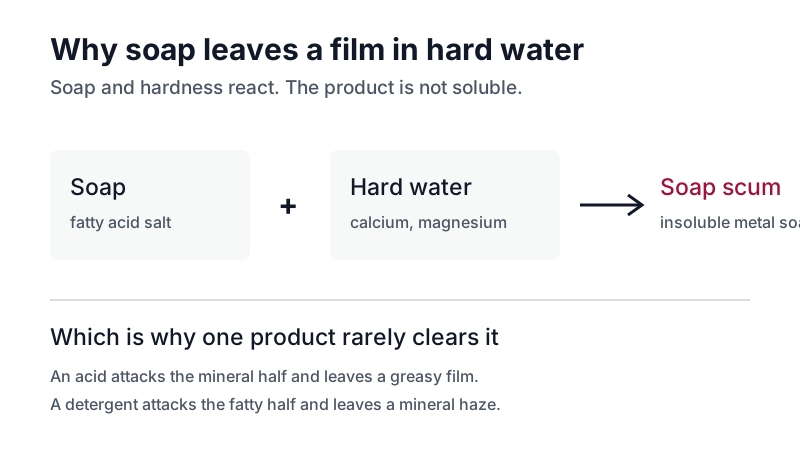
Hard water is water carrying dissolved calcium and magnesium compounds, acquired as rain percolates through carbonate rock, which is why hardness is a property of geology rather than of plumbing and varies sharply between neighbouring regions. Three consequences follow, and they look unrelated until the cause is named. Hardness ions react with soaps and interfere with surfactants, so more detergent is needed to achieve the same effect — which is what laundry builders and chelating agents are added to formulations to address. Heating hard water drives dissolved calcium bicarbonate out of solution as insoluble calcium carbonate, which is limescale, and explains why scale forms on heating elements and inside kettles far faster than on cold surfaces. And hard water evaporating in place leaves its mineral content behind as a visible film, which is why water marks are a hard-water problem and why rinsing with clean water and then drying actively is the trade recommendation rather than a fastidious extra. The practical point is that hardness is worth knowing about your own supply, because it converts three recurring annoyances into one explanation with one set of answers.
Why
- Descaling is explained by Water hardness
- Rinsing and drying is explained by Water hardness
- Limescale is explained by Water hardness
- Water marks is explained by Water hardness
- Sunscreen is explained by Water hardness
The unusual case: hard water normally leaves a deposit you can see. Here it supplies the iron that turns an invisible residue into an orange stain.
- Stainless steel is explained by Water hardness
- Soap is explained by Water hardness
- Soap scum is explained by Water hardness
- Dishwasher salt is explained by Water hardness
- Anionic surfactant is explained by Water hardness
- Non-ionic surfactant is explained by Water hardness
- Water-borne film is explained by Water hardness
Sources for this page
Sources
Care and Maintenance of Stainless Steel
British Stainless Steel Association, Stainless Steel Advisory Service, 2001 · Trade or professional body
Relied on for: That adherent hard water scales form on stainless steel and are treated with acid, and that clean potable rinsing water and active drying avoid water marking. (states this directly)
Handbook of Detergents (Surfactant Science Series)
CRC Press / Taylor & Francis · Reference work
Relied on for: That water hardness arises from dissolved calcium and magnesium, reduces detergency through interaction with surfactants, and is addressed by builders and chelants. (background and mechanism only)