Stainless steel
Steel protected by a self-repairing chromium oxide layer. Resistant to most household cleaning, and specifically vulnerable to chlorides and to abrasion across the grain.
What not to do
Sodium hypochlorite (chlorine bleach) may damage Stainless steel
Best avoided
The available guidance advises against this.
Chloride, not oxidation, is the problem: chloride ions break down the passive layer locally and produce pitting.
Precautions
- Limit the contact time
- Rinse thoroughly afterwards
- Never mix with other cleaning products
Evidence
Supported
Sources
Cleaning methods for stainless steel
British Stainless Steel Association · Trade or professional body
Relied on for: That chloride-containing solutions including hypochlorite bleaches can cause unacceptable surface staining and pitting and should not be used, that contact time must be minimal where they are used, and that soaking sinks or cookware in dilute bleach overnight is not advisable. (states this directly)
Care and Maintenance of Stainless Steel
British Stainless Steel Association, Stainless Steel Advisory Service, 2001 · Trade or professional body
Relied on for: That chloride solutions are not to be used on stainless steel in the treatment of stains and water marking. (states this directly)
Hydrochloric acid is unsafe on Stainless steel
Unsafe
Do not do this. The risk is established, and it is described below.
Precautions
- Wear gloves
- Wear eye protection
Evidence
Strongly supported
Sources
Right to Know Hazardous Substance Fact Sheet: Hydrogen Chloride (RTK 1012)
New Jersey Department of Health, 2016 · Government or regulator
Relied on for: That hydrogen chloride corrodes steel. (states this directly)
Care and Maintenance of Stainless Steel
British Stainless Steel Association, Stainless Steel Advisory Service, 2001 · Trade or professional body
Relied on for: That chlorides attack the passive layer on stainless steel and cause pitting corrosion. (states this directly)
Oxalic acid is unsafe on Stainless steel
Unsafe
Do not do this. The risk is established, and it is described below.
Precautions
- Wear gloves
- Wear eye protection
- Rinse thoroughly afterwards
Evidence
Supported
Sources
Right to Know Hazardous Substance Fact Sheet: Oxalic Acid (RTK 1445)
New Jersey Department of Health, 2010 · Government or regulator
Relied on for: That oxalic acid corrodes steel. (states this directly)
Sulphuric acid is unsafe on Stainless steel
Unsafe
Do not do this. The risk is established, and it is described below.
Precautions
- Ventilate the area
- Wear gloves
- Wear eye protection
- Consider professional help
Evidence
Strongly supported
Sources
Right to Know Hazardous Substance Fact Sheet: Sulfuric Acid (RTK 1761)
New Jersey Department of Health, 2016 · Government or regulator
Relied on for: That sulphuric acid reacts with most metals to produce flammable and explosive hydrogen gas. (states this directly)
Calcium hypochlorite is unsafe on Stainless steel
Unsafe
Do not do this. The risk is established, and it is described below.
Precautions
- Wear gloves
- Wear eye protection
- Ventilate the area
Evidence
Supported
Sources
Right to Know Hazardous Substance Fact Sheet: Calcium Hypochlorite (RTK 0323)
New Jersey Department of Health · Government or regulator
Relied on for: That calcium hypochlorite must be stored to avoid contact with metals and metal salts since violent reactions occur. (states this directly)
Care and Maintenance of Stainless Steel
British Stainless Steel Association, Stainless Steel Advisory Service, 2001 · Trade or professional body
Relied on for: That chlorides attack the passive layer on stainless steel and cause pitting. (states this directly)
Steel wool is unsafe on Stainless steel
Unsafe
Do not do this. The risk is established, and it is described below.
Precautions
- Test on an inconspicuous area first
Evidence
Strongly supported
Sources
Care and Maintenance of Stainless Steel
British Stainless Steel Association, Stainless Steel Advisory Service, 2001 · Trade or professional body
Relied on for: That carbon-steel implements and steel wool leave iron particles on stainless steel which corrode and appear as rust staining. (states this directly)
Precautions
- Rinse thoroughly afterwards
In detail
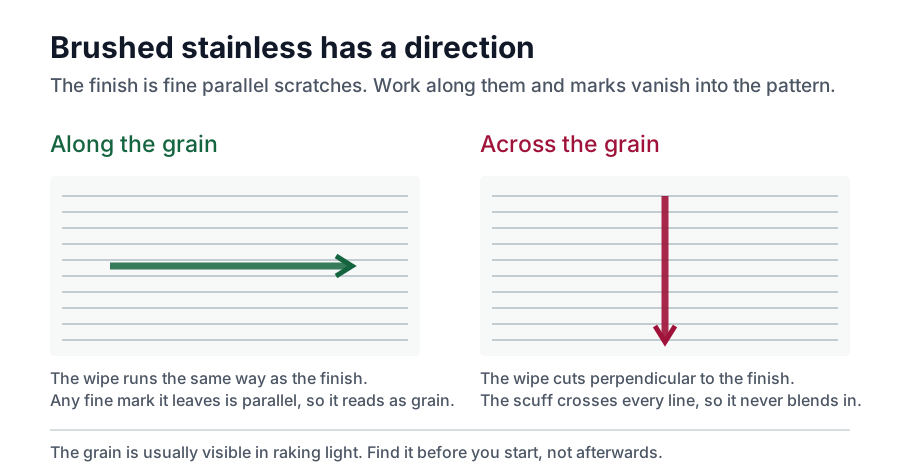
Stainless steel is not inherently unreactive. It resists corrosion because its chromium content forms a very thin chromium-rich oxide film across the surface, and that film reforms by itself when scratched, provided oxygen is available. The trade association is blunt that this does not make it maintenance-free: it stains and discolours from surface deposits, and its corrosion resistance depends on being kept clean. Cleaning it is therefore mostly about not damaging the film and not leaving anything on it that stops the film reforming. Chlorides are the classic problem: chloride ions break the passive layer down locally and produce pitting corrosion, which is why hypochlorite bleach and hydrochloric acid cleaners are advised against outright, why salty residues left after cooking matter, and why thorough rinsing counts for more than the choice of cleaner. Abrasion is the other: most stainless finishes are directional, and working across the grain leaves marks that cannot be polished out without refinishing the panel. Rust spots on stainless steel are usually not the steel rusting — they are particles of carbon steel from wire wool or a scouring pad, corroding on the surface.
Properties
Sensitivity
- Acids
- Sources disagree
- Alkalis
- Not known
- Chlorine bleach
- Sensitive
- Abrasion
- Sensitive
- Porous
- Not applicable
“Not known” means nobody has established this, not that the material is unaffected.
What works
Detergent is safe on, in specific conditions, Stainless steel
Safe only in specific conditions
This is only appropriate within specific limits. Outside those limits, no claim is made.
Only within these limits:
- Soap or mild detergent in warm, clean water
- Rinse with clean water afterwards
- Dry actively rather than letting the surface air-dry, or water marks form
The trade association's routine-cleaning recommendation. The rinse and the dry are part of it rather than optional refinements.
Precautions
- Rinse thoroughly afterwards
Evidence
Supported
Sources
Care and Maintenance of Stainless Steel
British Stainless Steel Association, Stainless Steel Advisory Service, 2001 · Trade or professional body
Relied on for: That washing with soap or mild detergent and warm water followed by a clean water rinse is adequate routine cleaning for domestic stainless steel equipment, and that drying avoids marking. (states this directly)
Mild cream cleanser is safe on, in specific conditions, Stainless steel
Safe only in specific conditions
This is only appropriate within specific limits. Outside those limits, no claim is made.
Only within these limits:
- A mild, non-scratching cream — not a paste carrying abrasive additions
- Applied with a soft cloth or sponge, worked along the grain on a directional finish
- Rinsed off with clean water and dried
- No chloride-containing product
Precautions
- Rinse thoroughly afterwards
- Test on an inconspicuous area first
Evidence
Supported
Sources
Care and Maintenance of Stainless Steel
British Stainless Steel Association, Stainless Steel Advisory Service, 2001 · Trade or professional body
Relied on for: That mild non-scratching creams applied with a soft cloth or sponge and rinsed off are the treatment for stubborn spots, water marking and light rust staining, that abrasive additions are to be avoided, and that chloride solutions must not be used. (states this directly)
Solvent wiping is safe on, in specific conditions, Stainless steel
Safe only in specific conditions
This is only appropriate within specific limits. Outside those limits, no claim is made.
Only within these limits:
- Methylated spirit, isopropyl alcohol or acetone
- Ventilate, and keep away from ignition sources — these solvents are flammable
- Never on a surface that has had bleach on it without rinsing first
Hypochlorite reacts with alcohols to form chloroform, so the sequence matters as much as the choice of product.
Precautions
- Ventilate the area
- Never mix with other cleaning products
- Rinse thoroughly afterwards
Evidence
Supported
Sources
Care and Maintenance of Stainless Steel
British Stainless Steel Association, Stainless Steel Advisory Service, 2001 · Trade or professional body
Relied on for: That hydrocarbon solvents — methylated spirit, isopropyl alcohol or acetone — are the recommended treatment for oil and grease marks on stainless steel. (states this directly)
Hazard Alert — Worker Health and Safety: Mixing Bleach with Other Cleaning Products Can Be Deadly
New Jersey Department of Health, Environmental and Occupational Health Surveillance Program · Government or regulator
Relied on for: That bleach combined with rubbing alcohol forms chloroform. (states this directly)
Acetic acid (vinegar) is safe on, in specific conditions, Stainless steel
Safe only in specific conditions
This is only appropriate within specific limits. Outside those limits, no claim is made.
Only within these limits:
- For removing adherent hard-water scale, as a defined operation with an end
- Never combined with salt, and never left as a residue
- Rinse thoroughly with clean water and dry afterwards
- Never applied where bleach or a hypochlorite product is present
The same trade body that lists a dilute vinegar soak for scale warns that salt and vinegar mixtures cause pitting over time. The variable is chloride and dwell time, not the vinegar.
Precautions
- Rinse thoroughly afterwards
- Never mix with other cleaning products
- Limit the contact time
Evidence
Supported
Sources
Care and Maintenance of Stainless Steel
British Stainless Steel Association, Stainless Steel Advisory Service, 2001 · Trade or professional body
Relied on for: That soaking in a 25 per cent vinegar solution and working the deposit with a nylon brush is a stated treatment for adherent hard water scale on stainless steel, followed by rinsing and drying. (states this directly)
Cleaning methods for stainless steel
British Stainless Steel Association · Trade or professional body
Relied on for: That concentrated salt and vinegar mixtures may cause pitting over a period of time, which bounds the clearance. (states this directly)
Ammonia is safe on, in specific conditions, Stainless steel
Safe only in specific conditions
This is only appropriate within specific limits. Outside those limits, no claim is made.
Only within these limits:
- Dilute — the sheet specifies a 1% solution in warm clean water
- Applied with a clean sponge, soft cloth or soft-fibre brush
- Rinsed in clean water and dried afterwards
- Routine light soiling; a stronger solution is not what is cleared
Also named as a pre-soak for burnt-on food and carbon deposits, and as the neutraliser after a phosphoric acid descale. The clearance is for bare stainless steel and carries nothing about coated or fingerprint-resistant finishes.
Precautions
- Never mix with other cleaning products
- Ventilate the area
- Rinse thoroughly afterwards
Evidence
Supported
Sources
Care and Maintenance of Stainless Steel
British Stainless Steel Association, Stainless Steel Advisory Service, 2001 · Trade or professional body
Relied on for: That routine cleaning of light soiling takes soap, detergent or a dilute 1% ammonia solution in warm clean water, applied with a clean sponge, soft cloth or soft-fibre brush then rinsed and dried, and is satisfactory on most surfaces. (states this directly)
Controlled resurfacing is safe on, in specific conditions, Stainless steel
Safe only in specific conditions
This is only appropriate within specific limits. Outside those limits, no claim is made.
Only within these limits:
- The FINEST abrasive medium consistent with covering the damage, not the most effective one
- The new scratch pattern aligned and blended with the original directional finish
- The result checked for aesthetic acceptability before going further
- Superficial drainer scratches may lift with a proprietary stainless cleaner or a car paint restorer instead
Stainless steel is homogeneous and does not rely on surface plating for its corrosion resistance, which is why resurfacing is possible at all — and why mechanical or electropolishing by a specialist is the stated route when domestic methods fail.
Precautions
- Test on an inconspicuous area first
- Check the manufacturer's instructions
Evidence
Supported
Sources
Care and Maintenance of Stainless Steel
British Stainless Steel Association, Stainless Steel Advisory Service, 2001 · Trade or professional body
Relied on for: That masking a scratch uses the finest abrasive medium consistent with covering the damage, with the new scratch pattern aligned and blended with the original directional finish; that superficial drainer scratches may lift with proprietary stainless cleaners or a car paint restorer; and that stainless steel is homogeneous and can be electropolished by specialists. (states this directly)
Mild abrasion is safe on, in specific conditions, Stainless steel
Safe only in specific conditions
This is only appropriate within specific limits. Outside those limits, no claim is made.
Only within these limits:
- Mild non-scratching creams — not abrasive pastes and not scouring powders
- A nylon abrasive pad, never a steel one
- Worked ALONG THE GRAIN on brushed and polished finishes
- Pre-soak burnt deposits first, so less force is needed at all
The finish is the constraint rather than the metal. A scratch across the grain on a brushed panel is permanent and visible from across a kitchen.
Precautions
- Test on an inconspicuous area first
Evidence
Supported
Sources
Care and Maintenance of Stainless Steel
British Stainless Steel Association, Stainless Steel Advisory Service, 2001 · Trade or professional body
Relied on for: That stubborn marks, water marking and light rust staining are treated with mild non-scratching creams while abrasive pastes are avoided, and that where a nylon abrasive pad is used on brushed or polished finishes it must be worked along the grain. (states this directly)
Soap is safe on, in specific conditions, Stainless steel
Safe only in specific conditions
This is only appropriate within specific limits. Outside those limits, no claim is made.
Only within these limits:
- Soap, detergent or a dilute one per cent ammonia solution in warm clean water
- Rinse and dry
- Wash after food preparation — salt, and concentrated salt and vinegar mixtures, may pit the steel over time
- No chloride solutions
The trade body rejects the idea that stainless steel is maintenance-free: it stains and discolours from surface deposits, and its corrosion resistance depends on the surface being kept clean.
Precautions
- Rinse thoroughly afterwards
Evidence
Supported
Sources
Care and Maintenance of Stainless Steel
British Stainless Steel Association, Stainless Steel Advisory Service, 2001 · Trade or professional body
Relied on for: That routine cleaning is soap, detergent or dilute one per cent ammonia solution in warm clean water, rinsed and dried, and that corrosion resistance depends on keeping the surface clean. (states this directly)
Why
- Stainless steel is explained by Corrosion and passivation
Stainless steel is not a metal that does not rust. It is a metal that repairs its own oxide film, and chlorides are what stop it doing so.
- Stainless steel is explained by Water hardness
- Stainless steel is explained by Chloride attack
- Stainless steel is explained by Cleanability is designed in
The reason stainless is the industrial default is a roughness figure, not the metal.
Related
- Stainless steel is commonly affected by Fingerprints
- Stainless steel is commonly affected by Water marks
- Stainless steel is commonly affected by Rust
- Stainless steel is commonly affected by Burnt-on food and carbon deposits
- Stainless steel is commonly affected by Grease
- Stainless steel is commonly affected by Heat tint
- Stainless steel is commonly affected by Limescale
Aftercare and prevention
- Descaling requires the aftercare Stainless steel
Rinsing and drying are part of the method, not a tidy-up: residue left in place is exposure that continues.
- Neutral cleaning requires the aftercare Stainless steel
- Soap requires the aftercare Stainless steel
Dry it. Water left to evaporate on stainless can mark it, and the mark comes from the water rather than from the dirt.
Hacks and claims involving this
- Aluminium foil for surface rust on chrome Established practitioner practice
- Steel wool for stubborn marks on stainless steel Does not work
- Leaving bleach in the sink overnight Does not work
- Following bleach with an alcohol sanitiser Does not work
- Drying a surface prevents water marks Supported
- Denture cleaning tablets for descaling Unresolved
- Using a dishwasher tablet outside the dishwasher Unresolved
- Cola for removing rust Unresolved
- Steam cleaning sanitises without chemicals Unresolved
- Fine steel wool for hard-water marks on stone Supported
- Decanting bleach into another container Does not work
- Alcohol cleaners are gentle, so they are safe Disputed
- Running bleach through a washing machine to clean it Disputed
Where the sources disagree
Stainless steel guidance offers a vinegar soak for scale and warns that vinegar causes pitting. Which is it?
The variable that differs between the two statements is not the vinegar — it is the chloride and the time. Pitting corrosion of stainless steel is initiated by chloride ions breaking down the passive layer at localised points, and acid accelerates it; the warning is about SALT AND vinegar together, left in place. The descaling instruction involves neither salt nor indefinite contact, and is followed in the same table by rinsing and drying. Read as two statements about vinegar they contradict; read as two statements about chloride residue they are the same statement seen twice.
What to do: An acid descaling treatment on stainless steel is a defined operation with an end: apply, work the deposit, rinse thoroughly with clean water, dry. What causes damage is residue left sitting — particularly anything salty — not the descaling itself. Never combine an acidic descaler with bleach or any other product, and rinse between products rather than following one with another.
The sources are answering different questions
Sources for this page
Sources
Care and Maintenance of Stainless Steel
British Stainless Steel Association, Stainless Steel Advisory Service, 2001 · Trade or professional body
Relied on for: That stainless steel stains and discolours from surface deposits, that corrosion resistance depends on keeping the surface clean, that chloride solutions must not be used, and that abrasive pads are worked along the grain. (states this directly)
Cleaning methods for stainless steel
British Stainless Steel Association · Trade or professional body
Relied on for: That chloride-containing solutions including hypochlorite bleaches cause surface staining and pitting, and that iron particle contamination rather than the steel itself is the usual source of rust staining. (states this directly)
ASTM A967/A967M, Standard Specification for Chemical Passivation Treatments for Stainless Steel Parts
ASTM International · Standards body
Relied on for: That the corrosion resistance of stainless steel derives from a chromium-rich passive oxide film. (background and mechanism only)