Washing machine door seal
The folded rubber ring around the door. Its top and its bottom were measured as different environments, and only the bottom is a problem.
Precautions
- Check the manufacturer's instructions
Start here
What this is, what tends to go wrong with it, and what to do about it.
Made from
What tends to go wrong
A living growth, not a stain. Killing it and removing the staining are two separate jobs, and neither addresses the moisture that caused it.
Why it is difficult: Porous and non-porous surfaces, Moisture control and recurrence, Cleaning, sanitising and disinfecting, Organic load, Surface roughness
The science behind this: Cleanability is designed in
Part of Washing machine.
In detail
The door seal is a folded rubber ring closing the gap between door and drum, and its geometry is the whole story: the fold that makes it seal also makes a channel holding water after the cycle ends, with a closed door leaving nowhere to evaporate to. The measurement bears this out with unusual clarity. Sampling the top and the bottom of the same seal on the same machines, a study found the top carried on the order of a hundred colony-forming units per square centimetre while the bottom was among the significantly contaminated sites. Same rubber, same machine, same wash — the only variable that differs is whether water drains off it or collects in it. That is why the seal is worth treating as its own problem rather than as part of the appliance. Advice at the level of the machine produces an instruction to clean the seal; the more precise fact is that the top is close to clean and the bottom is where anything you do belongs. It is also why the intervention with a mechanism behind it is drying rather than disinfecting — and the study tested no treatment.
What works
Detergent is safe on, in specific conditions, Washing machine door seal
Safe only in specific conditions
This is only appropriate within specific limits. Outside those limits, no claim is made.
A washer seal is scrubbed with a toothbrush. An oven gasket is not to be touched. The part decides, not the word 'seal'.
Only within these limits:
- Warm water with a MILD detergent, on a soft cloth or sponge
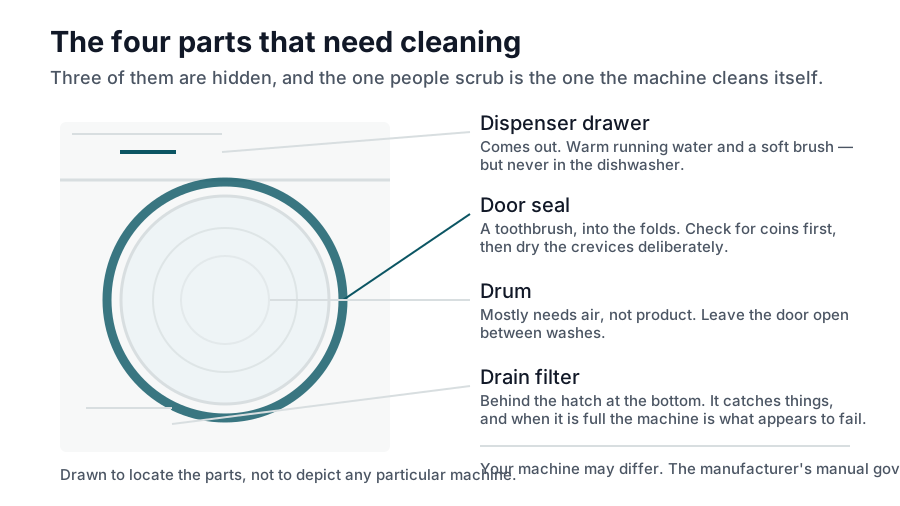
- A toothbrush for the crevices — the geometry is the problem, not the chemistry
- Check for coins and socks before scrubbing anything
- Dry the folds and crevices deliberately, then leave the door open
- No harsh chemicals and nothing abrasive
READ THIS BESIDE THE OVEN DOOR GASKET, which the manufacturer says not to clean, rub, damage or move. Two door seals on two appliances with opposite instructions. Neither generalises, and a reader who learns one as a rule will get the other wrong.
Precautions
- Check the manufacturer's instructions
Evidence
Supported
Sources
Cleaning a Front Load Washer Door Seal
Whirlpool Corporation · Manufacturer documentation
Relied on for: That the seal is cleaned with a soft cloth or sponge, warm water, mild detergent and a toothbrush, scrubbing the crevices, and dried carefully paying attention to folds and crevices, avoiding harsh chemicals or abrasive cleaners. (states this directly)
Why
- Washing machine door seal is explained by Cleanability is designed in
The folds are the design. The toothbrush exists because nothing applied flat reaches into them.
Related
- Washing machine door seal is made from Appliance seal rubber
- Washing machine door seal is commonly affected by Mould
Aftercare and prevention
- Detergent requires the aftercare Washing machine door seal
Dry the folds, then leave the door open. A seal cleaned and closed wet is back where it started within a week.
Hacks and claims involving this
- A hot empty wash cleans the machine Unresolved
- Leaving the washing machine door open Plausible mechanism, untested in this application
- Running bleach through a washing machine to clean it Disputed
Sources for this page
Sources
Microorganisms (MDPI), 2021 · Scientific literature
Relied on for: That the top and bottom parts of the rubber door seal were sampled separately, that the top carried approximately 11.1 x 10^1 CFU per square centimetre, and that bottom door seals were among the sites concluded to be significantly contaminated. (states this directly)