Washing machine
The appliance that cleans everything else, and the one whose own cleaning problem has actually been measured. The contamination is not spread evenly, which changes what to do about it.
Precautions
- Disconnect from the power supply first
- Check the manufacturer's instructions
- Never mix with other cleaning products
Start here
What this is, what tends to go wrong with it, and what to do about it.
Made from
Which part are you cleaning?
These parts take different answers. Cleaning one the way you clean another is a common way to damage this.
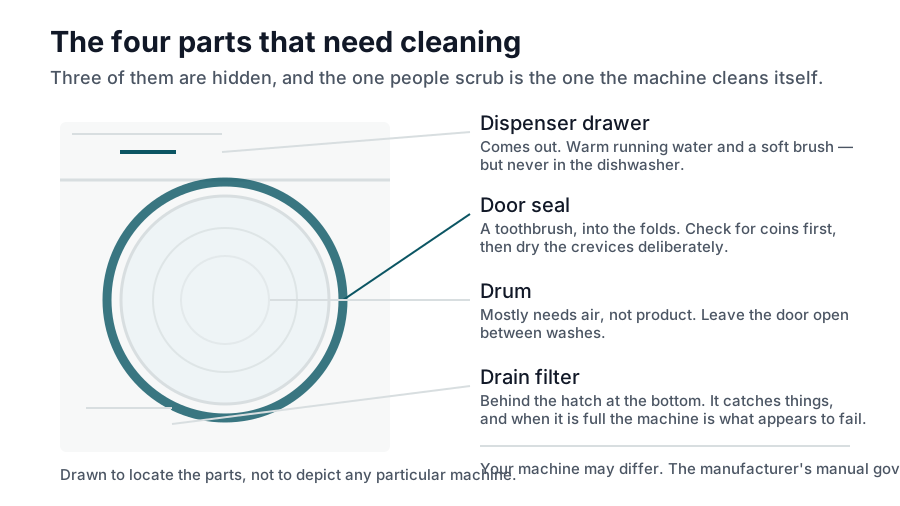
- Washing machine door seal
The folded rubber ring around the door. Its top and its bottom were measured as different environments, and only the bottom is a problem.
Appliance seal rubber
- Detergent drawer
The most heavily contaminated site measured in a domestic washing machine — despite being the part that holds the detergent.
Things not to use here
- Washing machine drain filter
A trap that catches what should never have reached the pump. Two manufacturers give two different intervals and only one says to unplug the machine — which is the whole answer to whether there is a general procedure.
- Detergent drawer housing
The cavity the drawer slides into, which almost nobody cleans — and which holds the residue and the growth that the drawer itself is blamed for.
Household plastics
Things not to use here
- Washer drum
The part that gets the most water and the least air. Almost everything recommended for it is about drying rather than cleaning.
Stainless steel
Things not to use here
What tends to go wrong
- Fingerprintsvia its material
Skin oils transferred by touch. A greasy soil rather than a dirty one, which is why water alone does not shift them and why they return immediately.
Why it is difficult: Surfactancy
- Water marksvia its material
What hard water leaves behind when it evaporates instead of being wiped away. A mineral film, not dirt, and the fix is at the drying stage.
Why it is difficult: Water hardness, Evaporative deposition
- Rustvia its material
Hydrated iron oxide from corroding iron or steel. Distinguish a surface deposit, which cleans off, from active corrosion of the item itself, which does not.
Why it is difficult: Corrosion and passivation, Why old stains are harder, Adhesion and cohesion
- Burnt-on food and carbon depositsvia its material
Food heated until it carbonised and bonded to the surface. Time and softening do the work; scouring powder does the damage.
Why it is difficult: Contact time, Carbonisation, Adhesion and cohesion, Why old stains are harder
- Greasevia its material
Fats and oils, which water alone cannot lift. Removed by surfactants, by heat, by solvents, or by alkalis that convert the fat into soap.
Why it is difficult: Why oil resists water, Emulsification
- Heat tintvia its material
The rainbow or brown bloom on stainless steel that has been heated. Not a deposit and not dirt: the metal's own surface oxide, thickened by heat.
- Limescalevia its material
A hard, chalky calcium carbonate deposit left by hard water. Dissolved by acids, essentially untouched by detergents.
Why it is difficult: Water hardness, Crystallisation, Adhesion and cohesion
- Mouldvia its component
A living growth, not a stain. Killing it and removing the staining are two separate jobs, and neither addresses the moisture that caused it.
Why it is difficult: Porous and non-porous surfaces, Moisture control and recurrence, Cleaning, sanitising and disinfecting, Organic load, Surface roughness
- Mildewvia its component
The flat, powdery surface growth that appears on damp fabric, grout and shower curtains — and the carpet trade's procedure for it names no bleach at all.
Why it is difficult: Moisture control and recurrence, Porous and non-porous surfaces, Organic load
- Washing machine microbiota· no established method
Established communities living on the wet surfaces of a domestic washing machine — which is why the smell returns on a schedule after every treatment.
Why it is difficult: Biofilm, Moisture control and recurrence
What the last clean left behind. It attracts soil, so the surface gets dirty faster — and the usual response is to use more of what caused it.
Why it is difficult: Residue and resoiling, Soil shielding, Why different surfaces get different dirt
The science behind this: Residue and resoiling, Corrosion and passivation, Water hardness, Chloride attack, Cleanability is designed in
In detail
A washing machine is unusual among appliances: somebody has counted. A peer-reviewed study sampled the two places machines are suspected of harbouring bacteria — the detergent drawer and the rubber door seal — and found both significantly contaminated, including potentially pathogenic species. The useful part is the distribution. The detergent chamber carried roughly four hundred times the load found on the TOP of the door seal, and the bottom of that same seal was contaminated while the top was not. That is a drainage result: water sits in the lower fold of a seal and in a drawer that never fully drains, and it is standing water rather than laundry the bacteria live in. The parts worth attention are the ones that stay wet. A home-hygiene review supplies the maintenance the study did not test. Biofilms build in machines run only at 30-40C on non-oxygen-bleach detergent. It asks for the drawer scrubbed WEEKLY, the seal wiped with weak bleach, the door and drawer left open to dry, and ONCE A WEEK OR EVERY FIFTH CYCLE a hot or disinfectant empty cycle — at the highest detergent level and longest time, because at low suds the water does not heat the interior enough.
Why
- Washing machine is explained by Residue and resoiling
Related
- Washing machine has the component Washing machine door seal
- Washing machine has the component Detergent drawer
- Washing machine has the component Washing machine drain filter
- Washing machine has the component Detergent drawer housing
- Washing machine has the component Washer drum
- Washing machine is made from Stainless steel
- Washing machine is commonly affected by Washing machine microbiota
Hacks and claims involving this
- A hot empty wash cleans the machine Unresolved
- Leaving the washing machine door open Plausible mechanism, untested in this application
- Running bleach through a washing machine to clean it Disputed
Sources for this page
Sources
Microorganisms (MDPI), 2021 · Scientific literature
Relied on for: That the detergent drawers and bottom door seals of domestic washing machines are significantly contaminated with cultivable bacteria including potentially pathogenic ones, and that the load differs by roughly two orders of magnitude between the detergent chamber and the top of the door seal. (states this directly)
Effectiveness of laundering processes used in domestic (home) settings
International Scientific Forum on Home Hygiene, 2013 · Scientific literature
Relied on for: That biofilms build up in machines run only at 30-40C with non-oxygen-bleach detergent and transfer to clothes, and its maintenance: weekly drawer cleaning, weak bleach on the rubber lining, door and drawer left open to dry, and a high-temperature or disinfectant empty cycle weekly or every fifth cycle at the highest detergent level and longest time. (states this directly)