Residue and resoiling
The cleaned patch that goes dirty faster than the carpet around it is not a coincidence and not bad luck. It is the cleaner you left behind, and the trade body treats it as a hazard with its own section.
In detail
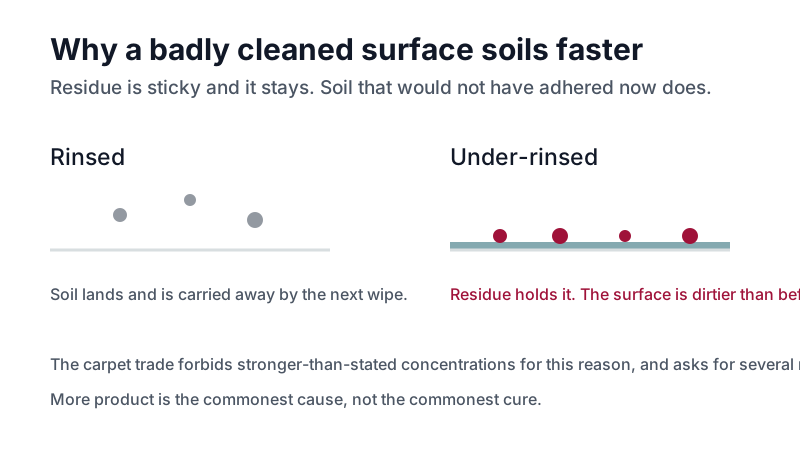
A treated spot that looks worse than its surroundings a month later was usually never finished. The carpet trade body gives residue a heading of its own — Residue Precautions — and the mechanism is blunt: many spot removal solutions leave residues in the carpet that attract soil. What is left behind is tacky, passing dirt sticks to it, and the patch collects soil faster than clean carpet does. The result appears weeks later, which is why nobody connects the two. The warning repeats on the individual agents. Detergent needs thorough rinsing because its residues cause rapid soiling. The amyl-acetate kind of nail polish remover, and the POG removers built on it, leave residues that must be flushed with a dry solvent. Two details make this preventive rather than corrective, and both are easy to skip. Rinsing is repeated — several rinses, blotting dry after each, not one pass. And the rinse is itself a risk: the recommendation is a mist sprayer, specifically to prevent overwetting, because the cure for one problem is a good way to cause another. The ban on exceeding the stated concentrations is the same logic. A stronger solution does not clean better; it leaves more behind.
Why
- Carpet: A textile floor covering where the instinctive response to a spill — scrubbing — is the one the trade body specifically rules out.
- Blotting: Lifting a spill straight up into an absorbent cloth rather than working at it. The opposite of what almost everyone does, and the trade bodies are explicit about why.
Why the last step of a blotting sequence is rinsing rather than stopping when the mark has gone.
- Glass cleaner: A product category built on fast evaporation rather than cleaning power — and the two ingredients that make it work are the two the mirror trade excludes.
- Hot-water extraction: Inject solution, recover it immediately. The recovery is the method — what is left behind is what causes the next problem.
- Neutral cleaning: The default that four separate trades converge on independently: a neutral detergent, warm water, a soft tool and a thorough rinse.
- Cleaning product residue: What the last clean left behind. It attracts soil, so the surface gets dirty faster — and the usual response is to use more of what caused it.
- Floor cleaner: A product category whose right answer is decided by the finish rather than by the floor. The wood trade says so in one sentence and it generalises.
- Upholstery cleaner: The category where the manufacturer decided before you bought it. The cleaning code on the label outranks anything the bottle claims.
- Polycarboxylate: The co-builder that keeps loosened soil in the water instead of letting it settle back onto the wash.
- Hot-water extraction machine: Injects solution into a soft surface and pulls it back out again. The extraction half is what distinguishes it from simply making a carpet wet.
The extraction half is the point. Detergent left in a carpet attracts soil faster than the carpet did.
- Finished wood: The finish is the surface, not the wood — and the two things that ruin it are water and the cleaners people reach for to remove water marks.
- Scrubber dryer: Lays down solution, scrubs it and vacuums it back up in one pass. The third of those three is the one that matters.
- Car interior: Four materials in a sealed box with a ventilation system running through it. Almost everything that goes wrong here goes wrong underneath, where nothing can reach it.
- Washing machine: The appliance that cleans everything else, and the one whose own cleaning problem has actually been measured. The contamination is not spread evenly, which changes what to do about it.
- Car seats: Fabric, leather or suede over foam that cannot come out of the car. One car maker's method is a mild neutral cleaner applied from the cloth, rinsed out, over the whole panel rather than the spot.
Sources for this page
Sources
Spot Solver: spot and spill removal procedures
The Carpet and Rug Institute (CRI) · Trade or professional body
Relied on for: The Residue Precautions section: that many spot removal solutions leave residues in the carpet that may attract soil, that the area is rinsed several times with lukewarm water, that a mist type sprayer is recommended to prevent overwetting, and that no solution may be used stronger than recommended. Also that detergent residues cause rapid soiling and POG removers need a dry-solvent rinse. (states this directly)
The Carpet and Rug Institute (CRI) · Trade or professional body
Relied on for: That after the spot has gone the area is blotted with clear water, once or more, to remove any remaining product. (states this directly)