Blotting
Lifting a spill straight up into an absorbent cloth rather than working at it. The opposite of what almost everyone does, and the trade bodies are explicit about why.
In detail
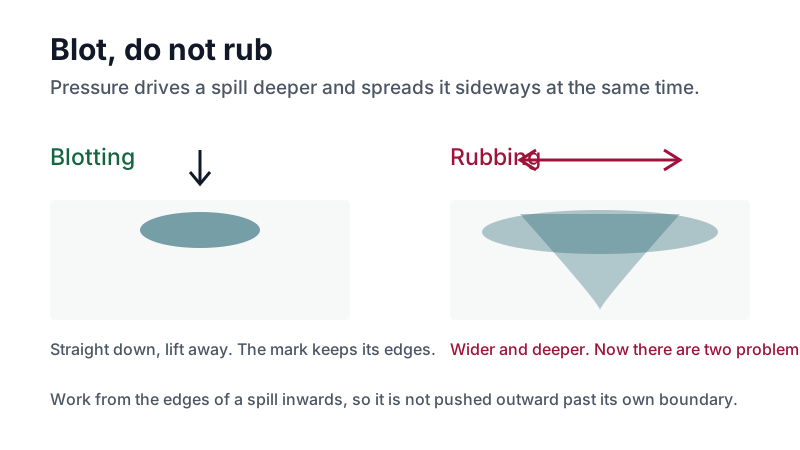
Blotting presses a dry absorbent cloth onto a spill and lifts it away, repeatedly, with no lateral movement at all. It is slower than rubbing and it feels ineffective, which is why it is the technique people abandon first — and it is what two separate trade associations specify for two unrelated surfaces. The carpet industry's guidance is to blot with a dry white cloth and explicitly not to scrub or use a brush, because bristles and scrubbing damage the carpet. The wood flooring association gives the same instruction for spills on a finished floor, because rubbing damages the finish. The reasoning is the same in both cases and it is not about the stain. Rubbing does three things: it drives the spill deeper into a porous structure, it spreads the mark outwards from where it started, and it abrades the surface itself — a carpet pile is distorted and a lacquer film is scratched, and neither is recoverable by cleaning. A white cloth is specified rather than any cloth, so that no dye transfers into whatever is being rescued.
What works
Blotting is safe on, in specific conditions, Carpet
Safe only in specific conditions
This is only appropriate within specific limits. Outside those limits, no claim is made.
Only within these limits:
- A dry white absorbent cloth or plain white paper towel — white, so no dye transfers
- No scrubbing and no brush at any point
- Cleaner applied to the cloth, not to the carpet, and worked from the edges to the centre
- Pretest any cleaner on an offcut or an out-of-the-way area first
- Blot with clear water afterwards to lift the remaining product
Precautions
- Test on an inconspicuous area first
Evidence
Supported
Sources
The Carpet and Rug Institute (CRI) · Trade or professional body
Relied on for: That liquids are blotted with a dry white absorbent cloth, that scrubbing and brushes are prohibited, that cleaner is applied to a cloth and worked from the edges to the centre, that pretesting is advised even for laboratory-tested products, and that the area is blotted with clear water afterwards. (states this directly)
Blotting is safe on, in specific conditions, Finished wood flooring
Safe only in specific conditions
This is only appropriate within specific limits. Outside those limits, no claim is made.
Only within these limits:
- A soft cloth, barely damp, with a cleaner made for the floor's finish
- Blot rather than rub — rubbing damages the finish
- Deal with the spill promptly; water through the seams is the real hazard
Precautions
- Check the manufacturer's instructions
Evidence
Supported
Sources
Maintenance, and How to Clean and Take Care of Your Wood Floors
National Wood Flooring Association (NWFA) · Trade or professional body
Relied on for: That spills are handled with a soft cloth and a small amount of pH-balanced wood floor cleaner, blotting rather than rubbing because rubbing can damage the finish. (states this directly)
Blotting is appropriate for Polished marble
Safe in the conditions described
Authoritative guidance supports this combination, within the conditions described below.
From the source's preventive section, which is about avoiding the problem rather than treating it.
Only within these limits:
- Immediately, with a paper towel
- Blot rather than wipe — wiping spreads the spill
- Followed by the routine neutral-cleaner wash where a mark remains
The instruction is one sentence and it is the whole of the emergency response the authority gives for a spill on stone.
Evidence
Supported
Sources
Care & Cleaning of Natural Stone
Natural Stone Institute · Trade or professional body
Relied on for: That a spill on natural stone is blotted with a paper towel immediately and the area is not wiped, because wiping will spread the spill. (states this directly)
Blotting is safe on, in specific conditions, Upholstery fabric
Safe only in specific conditions
This is only appropriate within specific limits. Outside those limits, no claim is made.
Only within these limits:
- Blot immediately — do not rub, and do not scrub
- Apply any solution to the CLOTH, never to the fabric
- Work from the edge of the mark inwards, so the mark does not spread
- Do not over wet; on an S-coded fabric do not use water at all
The upholstery standard's own instruction goes further than most readers expect: after blotting the spill, clean the ENTIRE PANEL seam to seam rather than the spot, or the result is a clean patch on a dirty arm.
Precautions
- Test on an inconspicuous area first
Evidence
Strongly supported
Sources
Woven & Knit Residential Upholstery Fabric Standards & Guidelines
Joint Industry Fabric Standards and Guidelines Committee, via the American Home Furnishings Alliance (AHFA) · Standards body
Relied on for: That a spill is blotted immediately to remove spilled material, that the entire panel is then cleaned seam to seam rather than the spot, that the fabric must not be over wet under W or saturated under S and WS, and that an inconspicuous area is pretested first. (states this directly)
The Carpet and Rug Institute (CRI) · Trade or professional body
Relied on for: That liquids are blotted with a dry white absorbent cloth, that cleaner is applied to the cloth rather than the surface and worked from the edges inward, and that scrubbing and brushes are excluded. (states this directly)
Why
- Blotting is explained by Mechanical action and abrasion
Explained by the absence of lateral force: rubbing drives the spill deeper, spreads it outwards, and abrades the surface itself.
- Blotting is explained by Classifying a stain by its origin
- Blotting is explained by Residue and resoiling
Why the last step of a blotting sequence is rinsing rather than stopping when the mark has gone.
- Blotting is explained by Penetration into fibres
Hacks and claims involving this
- Scrub a carpet stain to get it out Does not work
When the obvious answer is wrong
What should I use on red wine spilled on a wool carpet or jumper?
Wool is a protein fibre and oxidising bleaches attack it directly, degrading the keratin rather than the stain sitting on it. The damage is structural and it is not a mark that can be cleaned off afterwards: the fibre is weakened, and on a carpet the affected area wears differently from everything around it. The wool body approaches this from the other side, warning that methods aimed primarily at cotton or synthetic garments are not all suitable for wool.
A different kind of treatment works: Change the mechanism from oxidation to dilution and dissolution, and respect the order. The wool body gives red wine, fruit and fruit juice their own entry and its sequence is three steps. First RINSE WITH CLEAN WATER — before any product, because wine is water-soluble while it is fresh and the cheapest removal happens then. Second, a DILUTE solution of an approved wool detergent. Third, and only where the mark persists, THREE PARTS SURGICAL SPIRIT TO ONE PART COLD WATER. Technique carries the rest and is stated for every entry on the page: scoop or blot the excess immediately with white tissue or an absorbent towel, work from the EDGE towards the centre, and dab rather than rub. Finish with a wash in an approved wool detergent. Where the label permits dry cleaning and the mark survives, tell the cleaner what the stain is AND what has already been applied to it — a treated stain is a different problem from an untreated one.
What should I use on a greasy mark on a wool jumper?
Wool is a protein fibre, and the mechanism that converts fat to soap also hydrolyses protein. A strong alkali therefore attacks the garment on the same chemistry it uses on the stain, and the damage is to the fibre rather than to its appearance — it is not a mark that can be cleaned off afterwards. The wool body approaches the same problem from the other end, warning that methods primarily aimed at garments made from cotton or synthetic fibres are not all suitable for wool, and specifying a dilute wool detergent in TEPID water rather than anything stronger or hotter.
A different kind of treatment works: Change the mechanism from saponification to dissolution, and respect the order. The wool body's instruction for oily or greasy stains is that they are best treated with SOLVENTS FIRST, and that the solvent MUST BE ALLOWED TO EVAPORATE before any water-based treatment is subsequently carried out. That waiting step is the part most likely to be skipped and it is stated explicitly. The water-based stage that follows is a dilute solution of an approved wool detergent in tepid water — dilute rather than strong, tepid rather than hot. Technique carries the rest: scoop or blot the excess quickly with white tissue or an absorbent towel, work from the edge of the mark towards the centre, and do not rub. Where the mark survives that, the honest next step is professional cleaning rather than a stronger alkali.
How do I get limescale off a shower screen without damaging the glass?
The glass association's cleaning paper excludes acids from glass cleaning solutions as a class, naming hydrochloric and hydrofluoric as its examples, and warns that glass can be permanently damaged if it is infrequently or improperly cleaned. It also rules out the two things people escalate to when the acid does not work: abrasive cleaning materials, and razor blades or metal scrapers, which are excluded from routine cleaning altogether. The mechanism it gives for scratching is not the cleaner but trapped grit, so scrubbing a gritty screen is worse than leaving it.
It cannot be removed safely — prevent it instead: Treat this as a drying problem rather than a cleaning one, because that is where the deposit is actually created. The glass paper is precise about the mechanism from the other direction: its pure-water method requires water below 20 ppm total dissolved solids and states that tap water is not acceptable, because the rinse water is allowed to evaporate in place. Ordinary tap water left to evaporate on a screen deposits exactly what it was carrying. So the intervention with evidence behind it is removing the water before it dries — squeegee or blot the screen after each use, which is the same instruction the sanitaryware manufacturer gives for metal, where allowing water to evaporate forms deposits and the technique is to blot with a dabbing action rather than rub. For scale already established, no supportable method exists on this substrate: the acid that would dissolve it is excluded by the glass authority, and abrasives and blades are excluded too.
How do I get grease off a vinyl seat without leaving a mark on it?
The coated-fabric trade body classifies vinyl, polyurethane and silicone coated fabrics as SOFT-SURFACE materials despite their being smooth and non-permeable, and states that hard-surface cleaners, sanitizers and disinfectants are not intended for soft surfaces and could damage them. It then names hand sanitisers among the substances that STAIN coated fabric. So the alcohol wipe that removes the grease is on the list of things that mark the seat, and the mark it leaves is not a soil sitting on the coating that can be wiped off again.
A different kind of treatment works: Take the soil off first with a soft-surface product rather than a hard-surface one, and treat cleaning and disinfecting as two operations rather than one. The trade body is explicit that they are not the same: a soil-removal product may not disinfect and a disinfectant may not remove soil, and the surface should be clean of soil BEFORE anything is sanitised or disinfected. Then rinse, which is the step this source says almost nobody performs — it observes that technicians typically do not rinse coated fabric, so product residue is the normal state of the surface rather than the exception. A residue film is what makes a cleaned vinyl seat feel tacky and pick up the next mark faster. None of this applies to ordinary fabric upholstery, which is a different material with different guidance.
Sources for this page
Sources
The Carpet and Rug Institute (CRI) · Trade or professional body
Relied on for: That liquids are blotted with a dry white absorbent cloth or plain white paper towels, that scrubbing or using a brush is prohibited because bristles and scrubbing can damage carpet, and that cleaner is worked from the edges of a spot towards the centre. (states this directly)
Maintenance, and How to Clean and Take Care of Your Wood Floors
National Wood Flooring Association (NWFA) · Trade or professional body
Relied on for: That spills on a finished wood floor are gently blotted rather than rubbed, because rubbing can damage the finish. (states this directly)