Carpet
A textile floor covering where the instinctive response to a spill — scrubbing — is the one the trade body specifically rules out.
What not to do
Sodium hypochlorite (chlorine bleach) is unsafe on Carpet
Unsafe
Do not do this. The risk is established, and it is described below.
Colour loss on most textiles is complete or moderate and is correctable only by dyeing or patching. Olefin is the stated exception, and most people do not know which fibre they have.
Evidence
Strongly supported
Sources
Consumer Floor and Furnishings Care Information: carpet topics
Institute of Inspection, Cleaning and Restoration Certification (IICRC) · Trade or professional body
Relied on for: That complete or moderate colour loss occurs on most textiles exposed to chlorine bleach, that the usual result is light yellow to white discolouration, that only dyeing or patching can correct it, and that olefin is the exception. (states this directly)
Precautions
- Test on an inconspicuous area first
In detail
Carpet is a textile, and the useful thing to know about cleaning it is that almost everyone's first instinct is wrong. The carpet trade association's guidance is to blot with a dry white absorbent cloth or plain white paper towel and explicitly NOT to scrub or use a brush, because bristles and scrubbing damage the carpet — the fibres are distorted and the pile is broken, and unlike a stain that damage is structural. The same guidance has cleaner applied to the cloth rather than poured onto the carpet, worked in gently from the edges of the spot towards the centre so the mark is not spread outwards, and then blotted again. Two details are easy to skip and both matter. Pretesting on an offcut or an out-of-the-way area is advised even for products that have been laboratory tested, because carpet dyes and backings vary. And after the spot has gone, the area is blotted with clear water to lift the remaining product — residue left in a pile attracts soil and is why a treated patch often looks dirtier than its surroundings a month later. White cloths throughout, so no dye transfers.
Properties
Sensitivity
- Acids
- Not known
- Alkalis
- Not known
- Chlorine bleach
- Not known
- Heat
- Not known
- Abrasion
- Sensitive
- Porous
- Sensitive
“Not known” means nobody has established this, not that the material is unaffected.
What works
Blotting is safe on, in specific conditions, Carpet
Safe only in specific conditions
This is only appropriate within specific limits. Outside those limits, no claim is made.
Only within these limits:
- A dry white absorbent cloth or plain white paper towel — white, so no dye transfers
- No scrubbing and no brush at any point
- Cleaner applied to the cloth, not to the carpet, and worked from the edges to the centre
- Pretest any cleaner on an offcut or an out-of-the-way area first
- Blot with clear water afterwards to lift the remaining product
Precautions
- Test on an inconspicuous area first
Evidence
Supported
Sources
The Carpet and Rug Institute (CRI) · Trade or professional body
Relied on for: That liquids are blotted with a dry white absorbent cloth, that scrubbing and brushes are prohibited, that cleaner is applied to a cloth and worked from the edges to the centre, that pretesting is advised even for laboratory-tested products, and that the area is blotted with clear water afterwards. (states this directly)
Detergent is safe on, in specific conditions, Carpet
Safe only in specific conditions
This is only appropriate within specific limits. Outside those limits, no claim is made.
Only within these limits:
- A quarter teaspoon of liquid dishwashing detergent, non-bleach and non-lanolin, in one cup of lukewarm water
- Applied by saturating paper towels and blotting — never poured on the carpet
- Do not over wet; rinse with warm water and repeat while there is still transfer
- Not automatic dishwashing detergent and not laundry detergent
The trade body specifies the dilution to two decimal places of a teaspoon and excludes two whole product classes by name, which is a claim about what damages carpet rather than a recipe.
Precautions
- Test on an inconspicuous area first
Evidence
Strongly supported
Sources
CRI Technical Bulletin: Pet Urine and Carpet
The Carpet and Rug Institute (CRI) · Trade or professional body
Relied on for: The quarter-teaspoon dilution in one cup of lukewarm water, applied by saturating paper towels and blotting, the exclusion of automatic dishwashing and laundry detergent, the do-not-over-wet instruction, and the rinse-and-repeat endpoint. (states this directly)
Spot Solver: spot and spill removal procedures
The Carpet and Rug Institute (CRI) · Trade or professional body
Relied on for: The same dilution and the instruction never to go stronger, and that solution is applied to the cloth rather than to the carpet. (states this directly)
Carpet and fabric spot remover requires the precaution Carpet
Safe only in specific conditions
This is only appropriate within specific limits. Outside those limits, no claim is made.
Only within these limits:
- Pretest an inconspicuous area first
- Rinse the treated area with clear water afterwards, every time
- Do not use a product that claims rinsing or neutralising is unnecessary
- Evaporate half an ounce at label dilution in a glass first; a sticky residue there means a sticky residue in the carpet
The professional body's own recommendation is to try washing-up liquid in water before reaching for a proprietary spotter at all.
Precautions
- Test on an inconspicuous area first
Evidence
Strongly supported
Sources
Consumer Floor and Furnishings Care Information: carpet topics
Institute of Inspection, Cleaning and Restoration Certification (IICRC) · Trade or professional body
Relied on for: That many consumer spotters leave sticky soil-attracting residues, cause colour loss, yellowing and texture change even when directions are followed, the instruction to avoid products claiming no rinsing is needed, and the evaporation test. (states this directly)
Why
- Carpet is explained by Residue and resoiling
- Carpet is explained by Neutralising a spilled cleaning chemical
- Carpet is explained by Penetration into fibres
- Carpet is explained by Keratin digestion
- Carpet is explained by Dye migration and colour bleeding
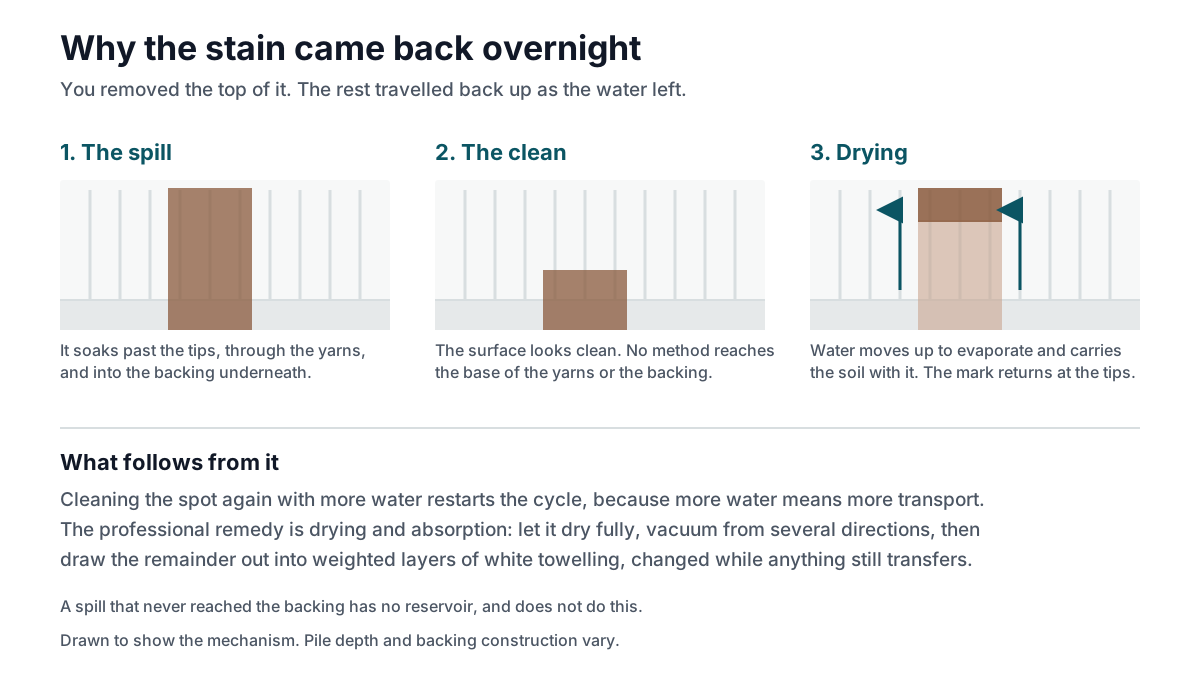
- Carpet is explained by Why a stain comes back after it dries
- Carpet is explained by Why there is a dark line along the skirting board
Related
- Carpet is commonly affected by Red wine
- Carpet is commonly affected by Grease
- Carpet is commonly affected by Blood
- Carpet is commonly affected by Chewing gum
- Carpet is commonly affected by Ink
- Carpet is commonly affected by Oil and grease on textile
- Carpet is commonly affected by Tea
- Carpet is commonly affected by Chocolate
- Carpet is commonly affected by Mud
- Carpet is commonly affected by Rust
- Carpet is commonly affected by Vomit
- Carpet is commonly affected by Emulsion paint
- Carpet is commonly affected by Lipstick and cosmetics
- Carpet is commonly affected by Grass
- Carpet is commonly affected by Glue and adhesive
- Carpet is commonly affected by Mould
- Carpet is commonly affected by Soot
- Carpet is commonly affected by Makeup
- Carpet is commonly affected by Candle wax
- Carpet is commonly affected by Crayon
- Carpet is commonly affected by Food colouring
- Carpet is commonly affected by Tomato stain
- Carpet is commonly affected by Gravy stain
- Carpet is commonly affected by Milk stain
- Carpet is commonly affected by Egg stain
- Carpet is commonly affected by Fruit juice
- Carpet is commonly affected by Hair dye
- Carpet is commonly affected by Hairspray residue
- Carpet is commonly affected by Nail varnish
- Carpet is commonly affected by Permanent marker
- Carpet is commonly affected by Pencil marks
- Carpet is commonly affected by Oil-based paint
- Carpet is commonly affected by Tree sap
- Carpet is commonly affected by Road salt
- Carpet is commonly affected by Tobacco residue
- Carpet is commonly affected by Faeces
- Carpet is commonly affected by Dust
- Carpet is commonly affected by Cleaning product residue
- Carpet is commonly affected by Mustard stain
- Carpet is commonly affected by Mildew
- Carpet is commonly affected by House dust mites
- Carpet is commonly affected by Pollen
- Carpet is commonly affected by Frass and pest residue
- Carpet is commonly affected by Filtration soil
- Carpet is commonly affected by Phenolic yellowing
- Carpet is commonly affected by Dander
- Carpet is commonly affected by Growth beneath a floor covering
- Carpet is commonly affected by Hair
- Carpet is commonly affected by Skin oil
Aftercare and prevention
- Hot-water extraction requires the aftercare Carpet
Hacks and claims involving this
- Scrub a carpet stain to get it out Does not work
- Mould needs bleach Does not work
- Hot water for a blood stain Does not work
- A stronger solution cleans better Does not work
- Freezing chewing gum off with ice Unresolved
- Lifting candle wax with a warm iron and paper Unresolved
- Letting mud dry before you touch it Disputed
- Using laundry detergent on a carpet stain Does not work
- Cornstarch or talc to draw out a grease mark Supported
- Enzyme cleaners for pet urine Unresolved
- Melting candle wax out with an iron and paper Unresolved
- Steam cleaning sets a pet urine stain Disputed
- Pouring salt on a red wine spill Unresolved
Sources for this page
Sources
The Carpet and Rug Institute (CRI) · Trade or professional body
Relied on for: That liquids are blotted with a dry white absorbent cloth and that scrubbing or using a brush is prohibited because bristles and scrubbing can damage carpet; that cleaner is applied to a cloth and worked from the edges to the centre; that any cleaner is pretested; and that the area is blotted with clear water afterwards to remove remaining product. (states this directly)