Shower
Four incompatible surfaces within arm's length of each other, permanently wet, and the two commonest deposits need opposite chemistry from the grout that joins them.
Start here
What this is, what tends to go wrong with it, and what to do about it.
Which part are you cleaning?
These parts take different answers. Cleaning one the way you clean another is a common way to damage this.
- Shower tray
Where everything that ran down the walls collects, in a material that is usually acrylic, from which abrasive cleansers are excluded.
Acrylic
Things not to use here
- Shower hose
A flexible sleeve over an inner tube, with a washer at each end. The outside is cleaned like the fittings it matches; a long soak is the risky part.
Chrome plating, Natural rubber
Things not to use here
What tends to go wrong
A hard, chalky calcium carbonate deposit left by hard water. Dissolved by acids, essentially untouched by detergents.
Why it is difficult: Water hardness, Crystallisation, Adhesion and cohesion
A living growth, not a stain. Killing it and removing the staining are two separate jobs, and neither addresses the moisture that caused it.
Why it is difficult: Porous and non-porous surfaces, Moisture control and recurrence, Cleaning, sanitising and disinfecting, Organic load, Surface roughness
The flat, powdery surface growth that appears on damp fabric, grout and shower curtains — and the carpet trade's procedure for it names no bleach at all.
Why it is difficult: Moisture control and recurrence, Porous and non-porous surfaces, Organic load
What hard water leaves behind when it evaporates instead of being wiped away. A mineral film, not dirt, and the fix is at the drying stage.
Why it is difficult: Water hardness, Evaporative deposition
- Pollenvia its material
A seasonal particulate that is part of ordinary dust for most of the year and overwhelms it for a few weeks. Dry removal first, because wet pollen stains.
Why it is difficult: Why different surfaces get different dirt
- Mould fungivia its material
The organisms behind the marking. Around 1.5 million species, each with its own conditions — and killing them does not end the exposure they created.
Why it is difficult: Organic load, Moisture control and recurrence, Biofilm
- Soap scum· no established method
Not scale and not dirt: a metal soap formed when hard water meets true soap. It is the reason a shower screen films over in one house and not another.
Why it is difficult: Insoluble metal soaps, Water hardness, Evaporative deposition, Adhesion and cohesion, Why different surfaces get different dirt
- Fungal spores· no established method
Already everywhere, water-repellent, and resistant to drying out. Removing them is not the goal, because it is not achievable — denying them moisture is.
Why it is difficult: Moisture control and recurrence, Water-repellent and water-attracting surfaces
Pressure-sensitive adhesive left behind when the paper tears away. It stays tacky by design, which is why it collects dirt and turns grey.
Why it is difficult: Adhesion and cohesion, Surface roughness
The science behind this: Leaching and clouded glass, Porous and non-porous surfaces, pH in cleaning, Surface roughness, Organic load, Cleanability is designed in
In detail
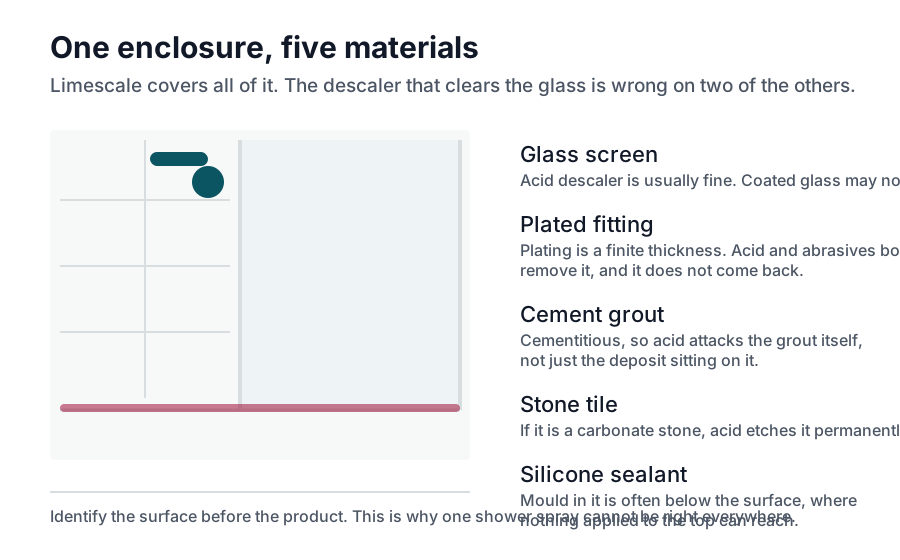
A shower is the hardest room-sized cleaning problem in an ordinary house, because it puts a glass screen, a plated fitting, a ceramic or stone tile, a cement-based grout and a silicone bead in contact with each other and keeps them wet. The two deposits it accumulates are limescale, a carbonate mineral that needs acid, and soap scum, a metal soap that needs a surfactant — and a single acidic spray attacks both plus the grout and any stone, because cement and carbonate stone are dissolved by the same chemistry as the scale. That is why the one-bottle approach fails here more visibly than anywhere else. A vitreous china manufacturer permits soft abrasive cleaners on the china, and a fittings manufacturer excludes abrasive cleaners from its acrylic, enamelled cast iron and plated finishes. The glass industry's cleaning guidance rules out abrasive cleaning materials on glass. And the recurring mould in the sealant is not a cleaning failure but a moisture one.
Related
- Shower has the component Shower tray
- Shower has the component Shower hose
- Shower is made from Glass
- Shower is made from Porcelain tile
- Shower is made from Grout
- Shower is made from Plated and coated tap finishes
- Shower is made from Silicone sealant
- Shower is commonly affected by Limescale
- Shower is commonly affected by Soap scum
- Shower is commonly affected by Mould
- Shower is commonly affected by Mildew
- Shower is commonly affected by Water marks
- Shower is commonly affected by Fungal spores
Hacks and claims involving this
- One spray for the whole bathroom Does not work
Sources for this page
Sources
Care & Cleaning: Toilets or Lavatories Made of Vitreous China
STERLING (Kohler Co.) · Manufacturer documentation
Relied on for: That soft abrasive cleaners may be used on vitreous china, and that splashes of cleaner are wiped from plastic or plated surfaces immediately. (states this directly)
Tile Council of North America (TCNA) · Trade or professional body
Relied on for: That cement-based grout is dissolved by acids and is better cleaned with an alkaline cleaner than an acid-based one. (states this directly)
Glass Technical Paper FB01-00: Proper Procedures for Cleaning Architectural Glass Products
National Glass Association (NGA) with the International Window Cleaning Association (IWCA), 2023 · Trade or professional body
Relied on for: That bristle brushes and abrasive cleaning materials are ruled out on glass. (states this directly)