Oven
Baked-on grease polymerised by heat, in an enclosure containing several materials with conflicting requirements.
What not to do
Sodium hydroxide is unsafe on Oven
Unsafe
Do not do this. The risk is established, and it is described below.
The damage is delayed: residue is what harms the cavity, and it does so on the next self-clean cycle.
Precautions
- Check the manufacturer's instructions
- Wear gloves
- Wear eye protection
- Ventilate the area
Evidence
Strongly supported
Sources
Use and Care & Installation Guide: Self-Cleaning Electric Range
GE Appliances · Manufacturer documentation
Relied on for: That no commercial oven cleaner of any kind should be used in or around any part of the oven, and that residue from oven cleaners will damage the inside of the oven when the self-clean cycle is used. (states this directly)
Unsafe
Do not do this. The risk is established, and it is described below.
Scope matters: the same manual prescribes an ammonia soak for a REMOVED drip pan.
Precautions
- Ventilate the area
- Never mix with other cleaning products
- Check the manufacturer's instructions
Evidence
Supported
Sources
Use and Care & Installation Guide: Self-Cleaning Electric Range
GE Appliances · Manufacturer documentation
Relied on for: That the metal parts of the range must not be cleaned with steel wool, abrasives, ammonia or commercial oven cleaners, and are instead washed, rinsed and dried with a soft cloth. (states this directly)
Precautions
- Ventilate the area
- Wear gloves
- Wear eye protection
- Check the manufacturer's instructions
- Do not apply to a hot surface
Start here
What this is, what tends to go wrong with it, and what to do about it.
Made from
Which part are you cleaning?
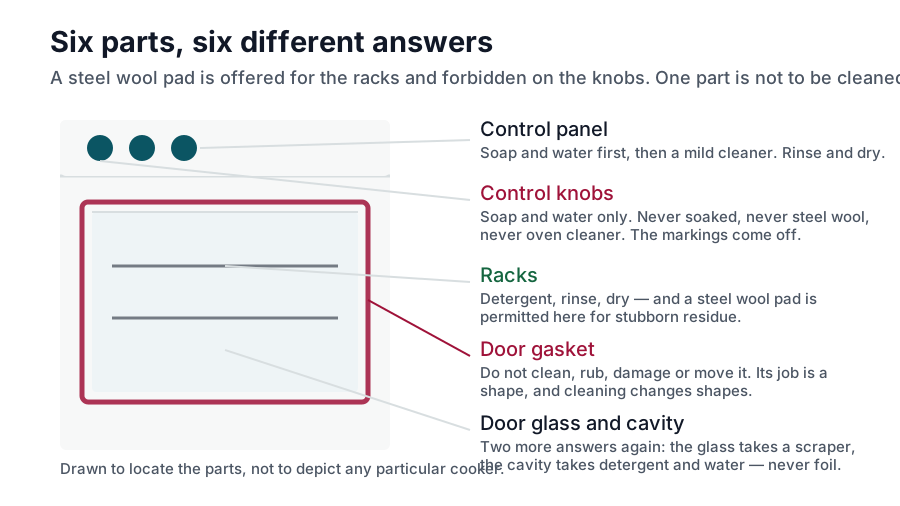
These parts take different answers. Cleaning one the way you clean another is a common way to damage this.
- Oven door seal
The one part of an oven the manufacturer says not to clean at all. Three zones of the same door take three different treatments.
Appliance seal rubber
Things not to use here
- Oven shelf
The one part of an oven the manufacturer sends steel wool at. Everything else in the appliance forbids abrasives; the shelves are cleaned with them.
- Oven door glass
Two faces of one pane with opposite instructions: the outside takes glass cleaner, and the inside is not cleaned by hand at all.
Things not to use here
- Oven control panel
The only part of a cooker where the manufacturer excludes abrasives of any kind — and the reason is the lettering, not the surface.
Things not to use here
- Drip pan
The one component where the manufacturer prescribes an ammonia soak — and forbids the foil lining almost everyone uses.
- Grill pan and grid
Two parts of one accessory with opposite rules: the manufacturer permits oven cleaner on the pan and prohibits it on the grid.
Things not to use here
- Control knob
The part of a cooker that gets the greasiest and tolerates the least. Steel wool is offered for the racks and forbidden here.
Household plastics
Things not to use here
- Oven interior
The cavity itself, which takes a different answer from the door, the racks and the outside — and where a foil liner does more harm than the spill did.
Vitreous enamel
Things not to use here
What tends to go wrong
Fats and oils, which water alone cannot lift. Removed by surfactants, by heat, by solvents, or by alkalis that convert the fat into soap.
Why it is difficult: Why oil resists water, Emulsification
Food heated until it carbonised and bonded to the surface. Time and softening do the work; scouring powder does the damage.
Why it is difficult: Contact time, Carbonisation, Adhesion and cohesion, Why old stains are harder
- Fingerprintsvia its material
Skin oils transferred by touch. A greasy soil rather than a dirty one, which is why water alone does not shift them and why they return immediately.
Why it is difficult: Surfactancy
- Water marksvia its material
What hard water leaves behind when it evaporates instead of being wiped away. A mineral film, not dirt, and the fix is at the drying stage.
Why it is difficult: Water hardness, Evaporative deposition
- Rustvia its material
Hydrated iron oxide from corroding iron or steel. Distinguish a surface deposit, which cleans off, from active corrosion of the item itself, which does not.
Why it is difficult: Corrosion and passivation, Why old stains are harder, Adhesion and cohesion
- Heat tintvia its material
The rainbow or brown bloom on stainless steel that has been heated. Not a deposit and not dirt: the metal's own surface oxide, thickened by heat.
- Limescalevia its material
A hard, chalky calcium carbonate deposit left by hard water. Dissolved by acids, essentially untouched by detergents.
Why it is difficult: Water hardness, Crystallisation, Adhesion and cohesion
The science behind this: Corrosion and passivation, Water hardness, Chloride attack, Cleanability is designed in, Alkali attack on light metals
In detail
Oven soil is not ordinary grease. Repeated heating polymerises fats into a hard, brown, cross-linked layer that is far less responsive to detergent than the fresh grease it started as, which is why oven cleaning so often reaches for aggressive chemistry. The strongly alkaline cleaners sold for the job work by saponification, converting the fat into soap that can be rinsed away, and they are genuinely effective. They are also the reason oven cleaning has more material restrictions than most tasks: strong alkalis attack aluminium components, damage some painted and anodised surfaces, and are hazardous to skin and eyes. Self-cleaning functions take an entirely different route, using very high temperatures to reduce the deposit to ash, and they carry their own manufacturer instructions about what must be removed from the cavity first. Oven racks, door glass, painted exteriors and any catalytic or pyrolytic liner each have different requirements, and a liner in particular can be permanently ruined by a chemical cleaner intended for the cavity.
What works
Pyrolytic (self-clean) cycle is appropriate for Oven
Safe only in specific conditions
This is only appropriate within specific limits. Outside those limits, no claim is made.
One manufacturer's own cycle, and not a fact about pyrolytic ovens generally.
Only within these limits:
- The range must be completely cool before the cycle can be set
- All cookware and aluminium foil removed — they cannot withstand the temperature
- Heavy spillage wiped up first, to reduce smoke and avoid needing a second cycle
- Vented with an open window or an extractor while it runs
The venting condition is not about the smell. This manufacturer states that the fibreglass insulation gives off a very small amount of carbon monoxide during the cycle.
Precautions
- Ventilate the area
- Do not apply to a hot surface
- Keep away from children and pets
Evidence
Supported
Sources
Use and Care & Installation Guide: Self-Cleaning Electric Range
GE Appliances · Manufacturer documentation
Relied on for: That the range must be completely cool to set a clean cycle, that cookware and foil are removed because they cannot withstand the temperature, that heavy spillage is wiped first, and that the fibreglass insulation gives off a very small amount of carbon monoxide during the cycle so venting is recommended. (states this directly)
Related
- Oven has the component Oven door seal
- Oven has the component Oven shelf
- Oven has the component Oven door glass
- Oven has the component Oven control panel
- Oven has the component Drip pan
- Oven has the component Grill pan and grid
- Oven has the component Control knob
- Oven has the component Oven interior
- Oven is made from Stainless steel
- Oven is made from Aluminium
- Oven is commonly affected by Grease
- Oven is commonly affected by Burnt-on food and carbon deposits
Hacks and claims involving this
- Using a dishwasher tablet outside the dishwasher Unresolved
- Using oven cleaner in a self-cleaning oven Does not work
- Lining hob drip pans with foil Does not work
- Oven cleaner on the grill pan and grid Disputed
- Food spills on an appliance can wait until you clean Does not work
- Soaking oven shelves in a bag with a dishwasher tablet Unresolved
Sources for this page
Sources
Kirk-Othmer Encyclopedia of Chemical Technology
John Wiley & Sons · Reference work
Relied on for: That alkaline hydrolysis converts fats to soaps, and that strong alkalis attack amphoteric metals such as aluminium.